
When 5% Try to Overrule 95%

Alberta’s “Rock the Vote” Campaign and the Fight Over Who Gets to Decide
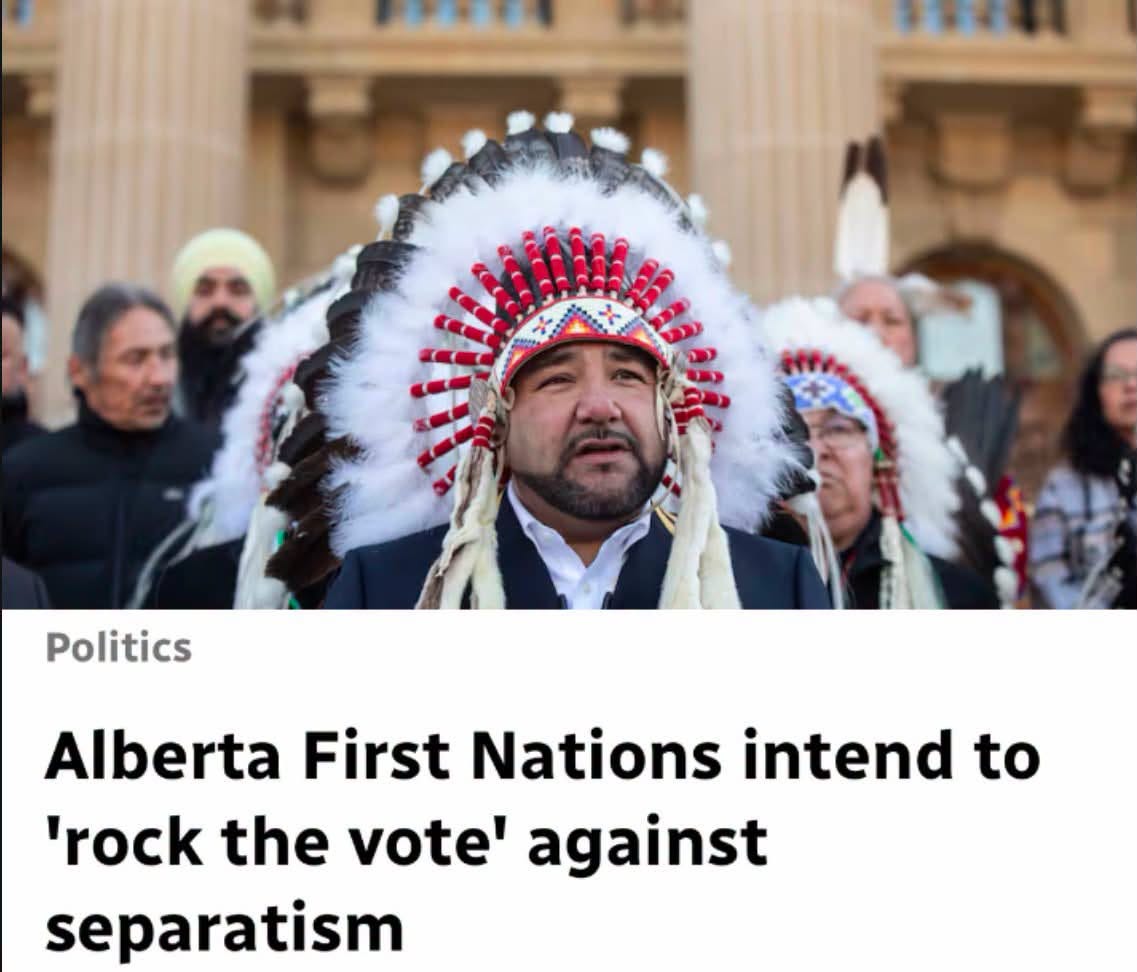
There’s a photograph making the rounds this week that tells you almost everything you need to know about where Alberta politics is headed this fall. A row of Treaty chiefs, resplendent in full headdress, stand on the steps of the Alberta Legislature. The headline above them: “Alberta First Nations intend to ‘rock the vote’ against separatism.”
It’s a striking image, and it announces a serious political effort. But it also raises a question that Alberta’s chattering class would rather not ask out loud: when a leadership group representing a single-digit share of the province’s population organizes to swing the outcome of a province-wide vote, who exactly is speaking for whom?
That is not a rhetorical cheap shot. It’s the actual structure of what’s unfolding ninety-some days before Albertans go to the polls.
What’s Actually Happening
According to Legacy Media, First Nations leaders in Alberta are preparing to replicate a “Rock the Vote”-style mobilization campaign aimed squarely at defeating the province’s separation question this October. It’s the latest and most organized escalation in a months-long standoff between Alberta’s Treaty leadership and Premier Danielle Smith’s government over the road to the referendum.
Here’s the timeline conservatives following this story need to know:
May 2025: Smith’s government amended Alberta’s Citizen Initiative Act, sharply lowering the signature threshold required to force a referendum question onto the ballot. The separatist advocacy group Stay Free Alberta seized the opening and claimed roughly 300,000 signatures in support of an independence vote.
May 13, 2026: Alberta’s Court of King’s Bench struck down the original petition, ruling that separatist organizers had failed to properly consult Indigenous peoples as required under Section 35 of the Constitution Act — the provision protecting existing treaty rights. Smith called the ruling wrong-headed but restructured the ballot question to move forward anyway.
June 2026: The Assembly of Treaty Chiefs escalated further, formally asking the RCMP to investigate whether the referendum drive itself amounts to treason. Smith fired back that the “overwrought language has no place in a democracy,” called the accusation “disgraceful,” and told the chiefs to “check themselves” — while noting she had publicly supported First Nations’ own parallel push for a renegotiated relationship with Ottawa and expected the same respect in return.
October 19, 2026: Albertans now head to the polls on a reworked question asking whether the province should remain part of Canada, or whether the Smith government should begin the constitutional process toward a binding separation referendum.
Public opinion, for what it’s worth, currently favours staying in Canada by a wide margin. An Angus Reid Institute survey taken May 22–24 found 60% of Albertans would vote to remain, versus 35% who’d back moving toward a separation referendum, with 5% undecided a 25-point spread. In other words, the “Rock the Vote” campaign isn’t chasing a photo finish. It’s organizing against a separatist movement that, per the best available public polling, is already losing.
That’s the detail that ought to reframe this entire story for conservative readers.
The Math Behind the Headline
Alberta’s 2021 Census recorded roughly 284,000 people who identify as Indigenous First Nations, Métis, and Inuit combined out of a provincial population that has since grown past 4.9 million. That works out to a little under 7% of Albertans overall, and the First Nations share specifically the population most directly represented by Treaty Chiefs and the leadership pictured on those legislature steps is smaller still, in the neighbourhood of the “5%” figure that’s been circulating in commentary on this story.
To be clear about what that number does and doesn’t prove: it is not an argument that Indigenous Albertans have no stake in this vote, or that their leaders have no right to campaign, organize, and speak. They have exactly the same right to political speech as every other Albertan and every other advocacy organization in the province the Alberta Federation of Labour, the Canadian Taxpayers Federation, the oil and gas sector, all of them lobby and organize too. Nobody serious disputes that.
What the number does illustrate is the asymmetry conservatives instinctively bristle at: a court, at the request of a leadership body representing a fraction of the electorate, was able to strike down a citizen-led petition that had already cleared a democratically lowered signature threshold before a single ballot was cast. That is a different thing from persuasion. Persuasion is what “Rock the Vote” is. A judicial veto on procedural consultation grounds is something else, and it’s the something else that should worry anyone who believes referendum questions ought to be settled by voters, not by which side can better navigate the courts.
Direct Democracy vs. Institutional Gatekeeping
This is the pattern conservative voters have watched play out again and again, from equalization referendums to carbon-tax challenges to now this: a populist, citizen-initiated push toward a ballot question, followed by a legal or institutional intervention that changes the terms before voters ever weigh in. Smith’s government didn’t invent the referendum process it lowered the bar to make citizen initiatives more accessible, which is the kind of small-d democratic reform conservatives generally applaud. That the very first major test of the lowered threshold ran into a courtroom is, at minimum, worth scrutinizing on the merits, separate from what anyone thinks about separatism itself.
You don’t have to support Alberta independence plenty of conservatives don’t, including much of Smith’s own caucus to think the process by which that question gets decided matters. The instinct behind “Rock the Vote” campaigns, get-out-the-vote drives, town halls, op-eds is healthy and exactly how democracies are supposed to resolve contested questions. The instinct behind pre-emptively narrowing what voters are even allowed to vote on is the one that deserves the tougher questions.
The Treason Accusation Backfire
If there’s a single moment that crystallized how far the rhetorical temperature has risen, it’s the Assembly of Treaty Chiefs’ request that the RCMP investigate the referendum campaign as potential treason. Smith’s response “this kind of overwrought language has no place in a democracy” will land with a lot of Albertans, and not only conservative ones, as simple common sense. Disagreeing with a referendum, even disagreeing strongly, is not treason. Calling it that doesn’t strengthen an argument; it signals that the argument’s proponents think the underlying case can’t win on persuasion alone.
That matters for the “Rock the Vote” push specifically. A get-out-the-vote campaign grounded in the actual merits economic risk, constitutional uncertainty, treaty obligations, the practical costs of separation is a legitimate and potentially persuasive contribution to the fall campaign. Pairing it with treason accusations against a sitting premier and a governing party risks discrediting the whole effort as overreach, and gives separatist organizers a grievance narrative they otherwise wouldn’t have.
Why This Fight Is Bigger Than Alberta
Strip away the specifics and this is a preview of a fight conservatives across the country are going to keep having: who gets to trigger a democratic process, who gets to slow it down once triggered, and whether “consultation” requirements however constitutionally grounded become a durable check on citizen initiatives generally. Western alienation didn’t appear out of nowhere; it’s the product of a couple generations of Albertans feeling that federal and often judicial institutions overrule regional majorities. Whatever you think of the separatist case itself, a referendum campaign that gets rerouted through the courts before voters weigh in is going to reinforce that grievance, not settle it.
The Other Side of the Argument
In fairness to the Treaty Chiefs and the Rock the Vote organizers, their position rests on more than headcount, and it deserves to be stated plainly rather than waved off. Section 35 treaty rights aren’t a matter of opinion poll math they’re constitutionally entrenched obligations the Crown owes to specific treaty nations, negotiated well before Alberta existed as a province, and Canadian courts have consistently held that governments must consult affected First Nations before taking actions that could affect those rights, regardless of what share of the general population those nations represent. From that vantage point, “5% versus 95%” is the wrong frame entirely: treaty nations aren’t simply a demographic voting bloc competing for influence, they’re parties to nation-to-nation agreements, and the King’s Bench ruling turned on that legal relationship, not on democratic weight. Reasonable people, including plenty of conservatives who support Alberta’s referendum process in principle, can and do conclude the court got the consultation question right even if they’d rather see the underlying independence debate resolved at the ballot box.
Bottom Line
Albertans will get their say on October 19. Between now and then, expect the “Rock the Vote” campaign to run hard, expect the treason rhetoric to keep making headlines whether or not it helps the cause it’s meant to serve, and expect the deeper argument about who gets to set the terms of a democratic vote before voters ever see a ballot to outlast this particular referendum by a long shot.
We’re building something bigger than one post.
If you want to help strengthen the team, you can support at BertaProudDad.com and keep this message moving. Together, we’re not just resisting the narrative; we’re replacing it.
Wear your opinion on your sleeve.
what is it called when foreign NGO’s are funding the 5% 🤔